LATEST DROPS
US shipping
Fast, tracked delivery across the United States. Easy returns within 30 days.
From the shop
Cold water, inside out, and almost no iron
Care
A printed shirt usually fades in the dryer, not in the sink. Heat cracks ink and shrinks cotton. The wash itself is the easy part.
If you want the graphic to look like the same shirt in six months, treat the print as ink on cloth. It can get wet. It should not get cooked.
Inside out, cold, and less soap than you think
Turn the shirt inside out before it goes in. The print then rubs against itself instead of against zippers, towels, and whatever else is in the load. Cold water. A normal cycle. The heavy-duty setting is for beach towels, not for a tee.
Use a regular detergent and stop when the shirt smells clean. Extra soap does not get it cleaner. It stays in the fibers. Skip fabric softener. It leaves a film, and after a few months a print starts to look chalky, as if someone dusted it.
Wash similar weights together when you can. A heavyweight garment-dyed tee and a thin tri-blend will both survive a shared load, but the thin one pills if it spends the whole cycle sanding against stiff cotton.
Hang it. The dryer is how a size changes.
Take the shirt out damp and hang it on a hanger with a real shoulder, not over a thin wire that pinches two points into the cloth. Smooth the side seams with your hands. Most wrinkles leave while it dries. You do not have to iron a tee that was hung properly.
If you use a dryer, low heat, and pull it out before it is bone dry. High heat is what cracks a vintage-style print and pulls a tee down half a size you did not order. Our hockey tees are cut to be worn as tagged. A hot dryer quietly rewrites that.
Iron the cloth, not the ink
A cotton tee rarely needs an iron. If the collar looks slept-in, press from the inside, on low, and keep steam off the graphic. Steam on the back panel and the hem is fine.
A light long-sleeve shirt is a different cloth. It wrinkles because it is thin, not because you did anything wrong. Hang it in the bathroom while the shower runs, or press it on low with a cotton cloth between the iron and the shirt. Do not spray water onto spots and then iron the wet marks. Those spots stay visible.
Stains: cold, and soon
Deodorant at the underarm and a drop of oil are different stains, and hot water sets both of them. People reach for hot water because it feels thorough. On a shirt, thorough is cold and prompt.
For deodorant buildup, a little dish soap on the mark, cold water, then the normal wash. For oil, blot. Do not rub it further into the weave. Wash it the same day if you can.
The shirt will still get old. Washed this way, it gets old evenly, which is the kind of worn-in people mean when they say they want a shirt to last.
Related: how we size a tee, if the fit is the part you are unsure about.
Measure a shirt you already wear
Fit
The letter on a tag is a factory’s guess, not a measurement of you. Two shirts can both say Large and sit an inch apart through the chest. If your “usual size” has ever arrived as a tent, you have already met this problem.
The fix is ordinary, which is why people skip it. Take a tee you already like, lay it flat, and measure that. Compare the numbers to the shirt you are buying. Ignore the letter until the numbers agree.
Lay it on a table, not on your body
Chest: from armpit seam to armpit seam, straight across, shirt smoothed, not stretched. That flat number is what most tee charts mean. Some charts list the full circumference instead. Read which one you are looking at before you double anything.
Length: from the top of the shoulder, beside the collar, down to the hem. Shoulder: seam to seam, if you can find the seam. On a regular tee that seam should sit near the point of your shoulder. If it lands halfway down your arm, the shirt is cut wide on purpose, or it is simply too big.
Write the numbers down. “The gray one from two winters ago” is not a size. Nineteen inches across the chest is.
When you are between two sizes
If your current shirts feel tight when you reach forward, go up. If the chest is fine and the hem looks like a short dress, stay, or try the smaller one. Do not size up “for comfort” and then spend the year tucking a yard of extra cloth into itself.
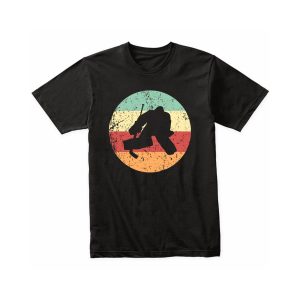
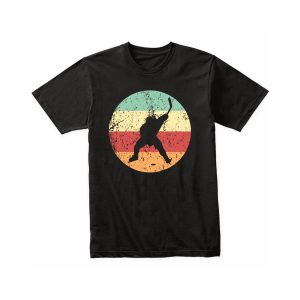
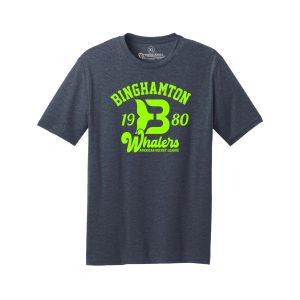
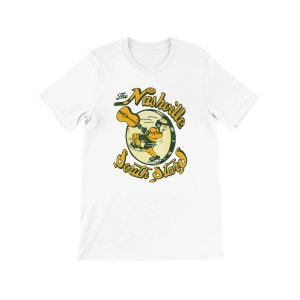
Hockey tees — the goalie, the player, the Nashville South Stars, the Whalers — are cut as regular men’s tees. If you wear a large in a standard cotton tee, start there.
The Whalers is a tri-blend. The cloth is lighter and drapes closer. The pattern is not smaller. Do not size up because it feels thin in the hand.
The heavyweight garment-dyed tee is the exception. It is cut a little oversized, with more shoulder and more air through the body. Order your usual size if you want that shape. Size down if you want it to sit like the hockey tees.
The long-sleeve shirts are not tees with extra fabric on the arms. Fit the shoulder. A body can be a bit easy. A shoulder seam that has slid toward the elbow will not be talked into looking right.
Wear it the way you will wear it
A long sleeve on its own should not pull across the back when you reach for something on a high shelf. Over a tee, it needs a little more room through the arm. Try both, or picture both, before you decide the size is wrong.
If you are stuck, email the chest measurement of a shirt you like and the piece you are looking at: [email protected]. A return is allowed for 30 days. A tape measure is faster.
Related: how to wash a printed tee so the size you chose is the size you still have after a month.
Heavy cloth, old crests, and sleeves again
Notes · 2026
Trend reports like to name one shirt, as if everyone agreed in January and then dressed in unison. That is not what you see on a sidewalk, or at a rink, or in line for coffee. Three things keep showing up. None of them are loud.
The cloth got heavier, and people stopped apologizing for it
A thin tee still has a job in July. It is not what you reach for when you want the shirt to look like itself after the tenth wash. Heavyweight cotton, especially garment-dyed cloth, holds a shape. The color is slightly uneven. A photo filter keeps trying to fake that. In person you can tell: the black is not a flat black, and the grey looks worn-in before you have worn it.
Weight changes the fit, too. A heavy tee can be roomy without looking cheap, because the fabric falls instead of clinging. The very oversized cut did not disappear. It calmed down. Shoulders are still a little wider than they were ten years ago. Hems are not at the knee. If a shirt only works when you pin it at the hip, it is a costume.
Graphics went back to things that already existed
New illustrations are everywhere, and a lot of them look like they were finished in the same afternoon. What looks considered this year is older source material: a hockey crest, a team from a league that does not exist anymore, a mark that has been printed on shirts longer than most of us have been buying them online.
A large graphic can still work. The test is whether it looks like it belongs on cloth. A crest with a little wear, on a shirt you can actually wash, reads as clothing. A print so large and so stiff that you are afraid to fold it reads as a poster that grew a collar. Both get worn. Only one of them goes with ordinary pants on a Wednesday.
Long sleeves came back as shirts
Not as a layer you hide under a hoodie. As the thing you leave on. A black long sleeve with a real shoulder. A white one that wrinkles a little and is allowed to. The uniform of tee, overshirt, jacket, for every temperature above freezing, got tiring. One long sleeve covers September through November, which in Chicago is most of the year that is not July.
What we are not putting on the rack
Shiny performance fabric pretending to be a tee. A tiny cropped men’s cut that only works if you never sit down. And any print that cannot survive a cold wash. If it needs a care manual longer than the shirt, it is not a shirt we want in October.
The rest is taste, and taste is allowed to be specific. Heavy cloth. An old crest. A sleeve when the weather asks for one. None of that is a trend so much as a correction, back toward shirts people keep.
If you want the practical versions: picking a size and washing a print.